Running an automotive dealership is a high-stakes balancing act. You are managing millions of dollars in rolling inventory, navigating thin margins, and trying to provide a seamless customer experience. But there is a shadow side to the business that keeps owners up at night: the constant threat of theft, vandalism, and fraudulent liability claims.
The reality is that traditional security methods—like chain-link fences and sleepy overnight guards—are no longer enough. Today’s criminals are faster, more organized, and bolder. This is where automotive dealership video monitoring steps in, transforming security from a passive “record and review” tool into a proactive, crime-stopping powerhouse.
In this guide, we will dive deep into why live video monitoring is the gold standard for dealership security and how it solves the most expensive problems facing the industry today.
The Hidden Costs of Poor Dealership Security
When most dealers think about security, they think about the price of a stolen car. But the true cost of a security breach runs much deeper.
1. The Catastrophic Loss of Inventory
It isn’t just about the car that goes missing. It’s the $5,000 in damage to the three cars the thieves hit while driving the stolen one off the lot. It’s the smashed windows, the stolen catalytic converters, and the stripped high-end wheels that leave vehicles on blocks.
2. Skyrocketing Insurance Premiums
Insurance companies are in the business of assessing risk. If your dealership is a frequent target for “smash and grabs,” your premiums will reflect that. In some extreme cases, dealerships have even faced the threat of losing their coverage entirely because their loss-ratio was too high.
3. The “False Damage” Nightmare
How many times has a customer returned a loaner car or picked up their vehicle from the service department only to claim a “new” dent or scratch? Without clear, high-definition video evidence of the vehicle’s condition upon arrival, the dealership often ends up eating the repair costs to keep the customer happy.
How Automotive Dealership Video Monitoring Solves These Problems
The shift from traditional CCTV to proactive video monitoring is like moving from a smoke alarm to a full-service fire department. One tells you after the building is gone; the other stops the fire before it spreads.
Real-Time Deterrence with “Talk-Down” Capabilities
Traditional cameras sit there and record. By the time you watch the footage the next morning, the thieves are long gone.
With live monitoring, AI-powered software detects movement in restricted areas after hours. A live agent in a monitoring center is instantly alerted. They can look at the screen, see a trespasser, and activate a Live Voice Talk-Down. Imagine a thief approaching a high-end SUV only to hear a booming voice over a loudspeaker say: “You in the red hoodie, you are trespassing on private property. The police have been dispatched.” In 99% of cases, the intruder flees immediately. Crime prevented. No police report needed.
AI-Powered Analytics: Sorting the Signal from the Noise
Old-school motion sensors are notorious for false alarms—a stray cat or a blowing plastic bag could trigger a notification. Modern automotive dealership video monitoring uses AI to distinguish between a branch moving in the wind and a human being crouching between rows of cars. This ensures that when an alert is sent, it’s a real threat, leading to faster response times and less “alarm fatigue.”
Coverage for Remote Storage Lots
Many dealerships have “overflow” lots or storage areas that lack power and internet infrastructure. Thieves often find these to be the easiest to steal from. Mobile Surveillance Units (MSUs) are one of the new ways to solve problems. These trailers are powered by the sun and have their own cameras and cell phone connections. You can drop them anywhere on your property, and they will cover the area all the way around without needing to dig any trenches for wires.
Operational Benefits Beyond Security
The main goal is to stop theft, but the information your video system collects can also help you make more money.
-
Customer Traffic Insights: See which parts of your lot attract the most foot traffic. Are people looking at the trucks or the EVs? Use this information to improve the layout of your lot.
-
Service Department Efficiency: Keep an eye on how quickly cars move through your service bays. Are there any problems? Is the “wash and vac” taking too long? Video helps you spot inefficiencies in real time.
-
Employee Safety and Accountability: Ensure that safety protocols are being followed in the shop and that customer interactions on the floor are professional.
The Numbers Speak for Themselves: A Case Study
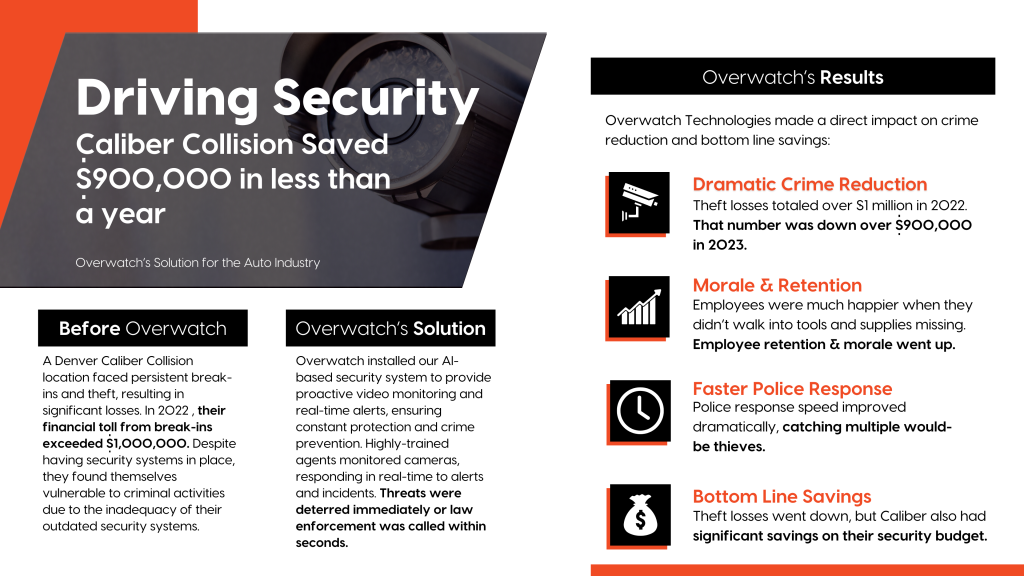
Consider a high-volume dealership in Denver that was losing over $1,000,000 annually to theft and vandalism. They were paying for a physical security guard, yet the crimes continued. After switching to an AI-powered live monitoring system (like the solutions provided by Overwatch), their losses dropped to under $100,000 in just one year.
The system didn’t just record the crimes; it stopped them from happening. The ROI (Return on Investment) was realized in less than six months.
FAQs: Everything You Need to Know
How does live video monitoring differ from traditional security cameras?
Traditional cameras are “passive”—they record footage that you watch after a crime has occurred. Live video monitoring is “active.” It uses AI to detect intruders in real-time and alerts live security professionals who can intervene immediately via loudspeakers or by calling the police.
Can your system capture license plates in the dark?
Yes. High-quality automotive dealership video monitoring systems use License Plate Recognition (LPR) cameras specifically designed to handle the glare of headlights and low-light conditions, capturing clear plate numbers of any vehicle entering or exiting your lot.
We have a huge lot. Is it too expensive to cover the whole perimeter?
It’s actually more affordable than you think. Because AI can “see” long distances and cover wide angles, you often need fewer cameras than you would with a traditional system. Additionally, when compared to the cost of a 24/7 physical security guard (which can exceed $100,000 a year), remote monitoring typically costs a fraction of the price.
How does the system handle “false claims” from customers regarding vehicle damage?
By installing high-definition cameras at the entry and exit points of your service lane, you create a “digital paper trail.” You can pull up crystal-clear footage of exactly what a car looked like the moment it was dropped off, effectively ending “he-said, she-said” disputes over scratches and dents.
What happens if the power or internet goes out?
Most professional-grade systems include battery backups and cellular failovers. For lots without any infrastructure, solar-powered mobile units provide a completely independent security solution that stays online regardless of local power outages.
Choosing the Right Partner for Your Dealership
Not all video monitoring companies are created equal. When shopping for a solution, ask these three questions:
-
Is the monitoring done by humans or just AI? You want a “Human-in-the-loop” system where an actual person verifies the threat.
-
What is the average response time? Seconds matter when a thief is trying to hotwire a car.
-
Is the hardware ruggedized? Dealership lots are harsh environments. Your cameras need to withstand extreme heat, rain, and snow.
The Bottom Line
In the automotive world, your inventory is your lifeblood. Leaving it protected by outdated technology is a gamble that eventually results in a loss. Automotive dealership video monitoring offers the peace of mind that comes with knowing a professional team is watching over your lot every single second of the night.
Ready to see how proactive monitoring can protect your inventory? [Schedule a Free Security Analysis] with our team today and discover the blind spots in your current setup before the thieves do.
Would you like me to put together a custom security checklist specifically for your lot size?